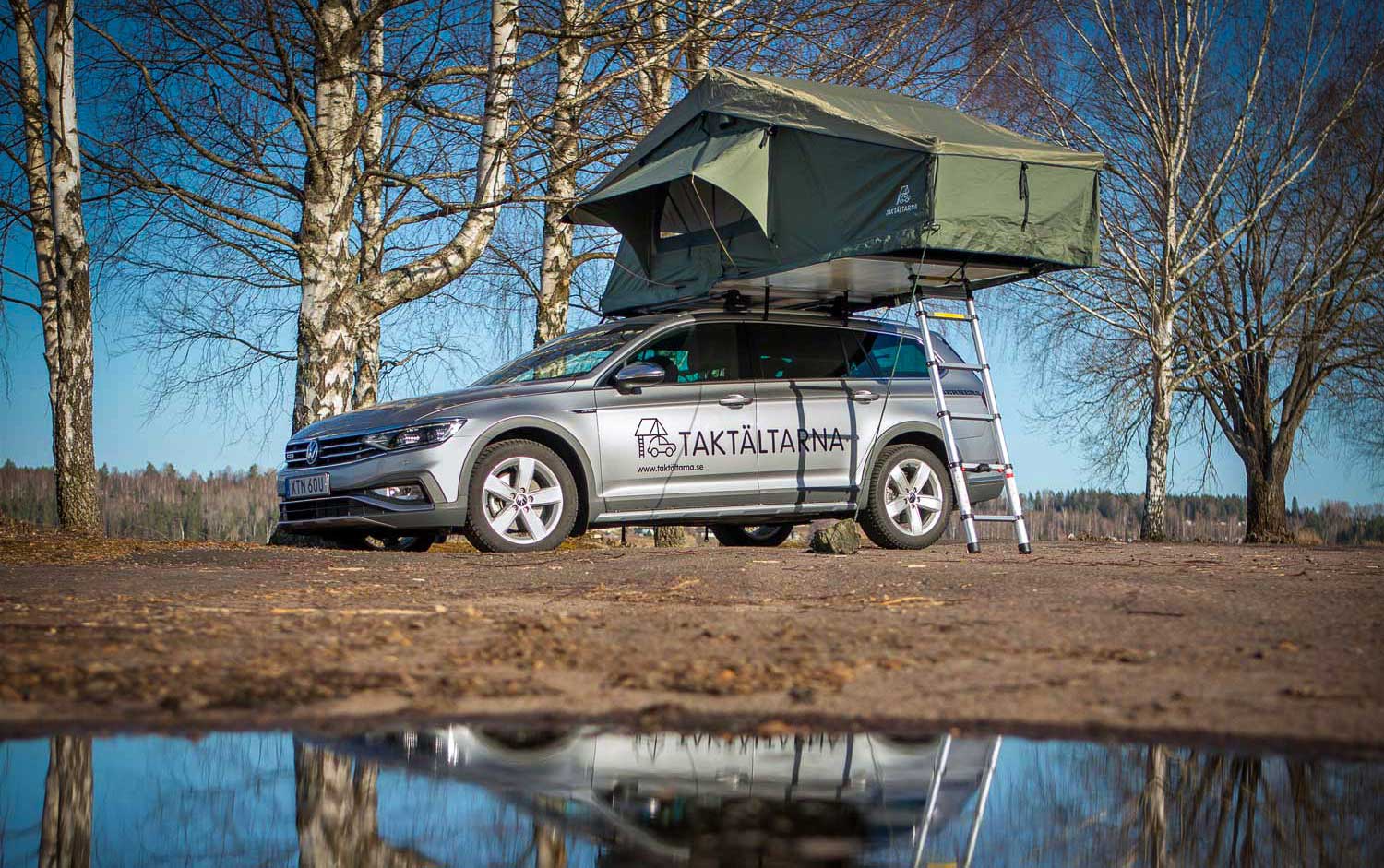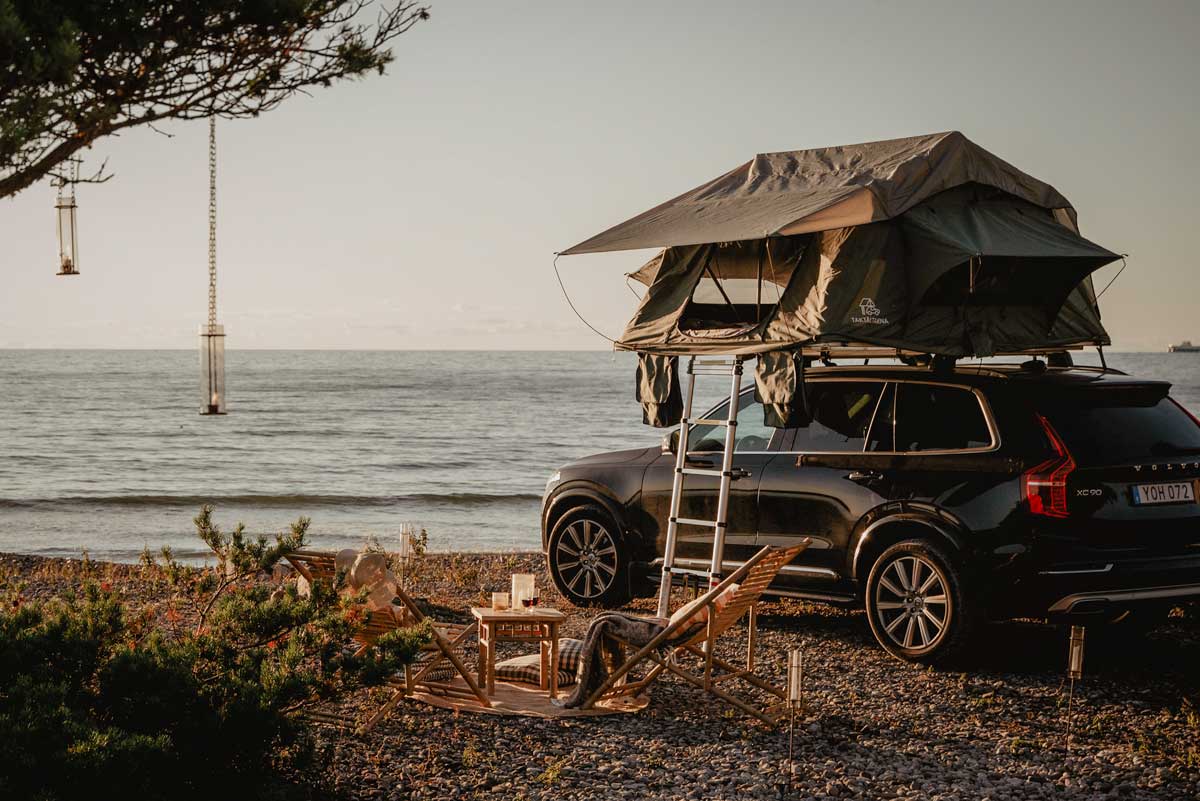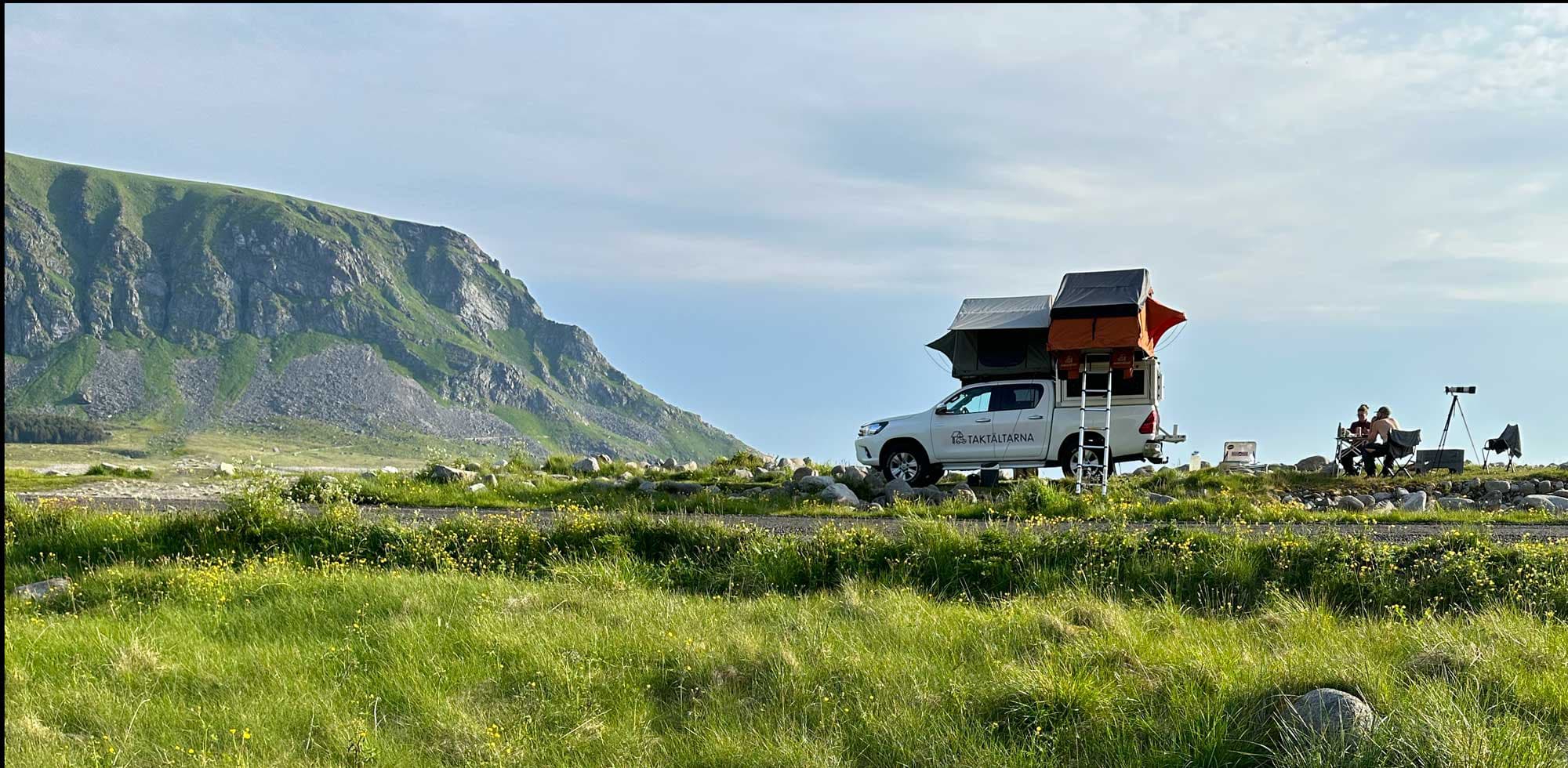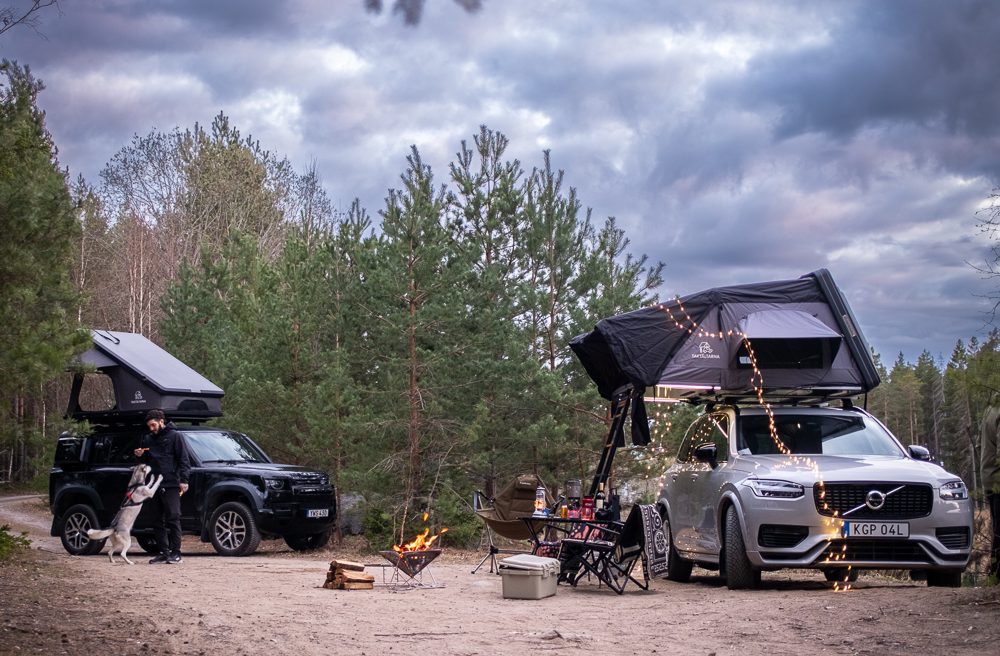


This is a republished report we at taktältarna made for Åka Skidor. It was first published in Åka Skidor issue 4, 2022. The roof tents we traveled with are of the model Åreskutan.
– Where shall we go then? The mountain guide Isaac Doude Van Troostwijk looks questioningly at the rest of us.
The time is just after 8 in the morning where we meet in a parking lot in Åre. The day before, the lifts took skiers up to the top of Åreskutan for the last time this season. Our goal is now to squeeze out the last of winter – the only question is where.
The reason we have not yet decided on this seemingly important detail is simply that we haven't needed to. In contrast to most ordinary ski trips where choosing a mountain and carefully researching hotels and cabin options is a must, this time we want to head where the conditions seem best for the day. We don't need to worry about accommodation, we have it with us on the car roof.

The closer the departure day came, the more obvious it became that the lasting memory from the trip would hardly be sunburn and goggle tan; spring winter simply hadn't really arrived.
The weather apps mostly predict subzero temperatures and a few degrees above zero for the coming days, and also quite a bit of wind.

Now we stand here and have to make a decision. We want to get out on a tour the same day, so the first stop should be somewhere not too many hours from Åre. Stora Blåsjön? Hemavan? Borgafjäll?
The choice falls on Kittelfjäll where weather, wind, and snow conditions seem good for the day. Sandra and Isaac have spent some time there during the winter and both have become fond of it. Our photographer Philip has also taken some of his favorite pictures there.

Roof tents have long been a common sight in more southern latitudes where vacationing with expedition vehicles is a thing. The advantages of a roof tent in more tropical environments are obvious – being off the ground provides protection both from predators' jaws and scorpions' stings.
However, it was in Europe that roof tents first began to be used sometime in the 1940s. During East Germany's heyday, roof tents were a common sight on the iconic Trabants, and of course, they have continued to be common in Germany, which is the absolute stronghold of camping life.

In recent years roof tents have also started to appear more and more on Swedish roads and have received a significant boost from the corona pandemic; it is a cheaper alternative to a motorhome and more comfortable than a regular tent.
Another phenomenon that has received a big boost during the pandemic is ski touring in our Swedish mountains, and Ola in our group is convinced that these two good things together must become three.
Our hypothesis is that it should be excellent for a spring winter trip with ski touring in good company. With accommodation on the car roof, we are not tied to any hotels and can steer the route entirely ourselves.

The time approaches three in the afternoon when we arrive at Kittelfjäll and we all start to get impatient. After a short discussion, we decide to climb Borkafjället which towers just west of Kittelfjäll.
We stop at a parking bay and quickly eat some sandwiches while we take out all the equipment.
– Does anyone else have crampons? Sandra asks.
Everyone shakes their heads.
On with the skis and off across the lake. Once on the other side, a steep climb begins up a stream ravine filled with concrete-like snow. Crampons would have been great…


After the steep part is done there follows a pleasant walk over the flats. The afternoon sun warms and the mood is high. Suddenly we see two figures approaching at a leisurely pace. (By the way, the only other people we will meet up in the mountains during our three days.)
One skis down the mountain with a pair of trick skis. The other, a burly man with a denim vest and long bushy beard, has come down using a sled, of all tools on planet Earth.
The thoughts inevitably go to ski history's most entertaining skier, Shane McConkey (AKA Saucer Boy) and, perhaps because we are on Borkafjäll, to the robber chief of the same name in Ronja Rövardotter. They happily inform us that they have been all the way up to the bowl in front of us and that the snow is really good.
A good way up in the mentioned bowl, we decide to traverse over to the steep cliff wall on our left side to get a bit dizzy and check out the magnificent view over Kittelfjäll.

Below us, the north side of Borkafjället drops off in a convex slope down towards Borkasjön. If you bring a rope and rappel the first part, it is possible to get down here on skis. We have neither that nor enough snow for the run to be possible.
Instead, we ski off in the other direction. Philip and Ola have spotted some nice turns on the other side and traverse over. The skiing here turns out to be at least varied. Everything from concrete snow and cardboard to 15-20 centimeters of powder. An entertaining run where the turns are performed sometimes in good skiing position, sometimes in the back seat – just as it easily becomes when the snow under the skis varies greatly. The rest of us ski down on the nice snow that has drifted into the large hollow. The run turns out much better than we dared hope to experience at the start of the day. Together we ski towards some small rocks and wind drifts that look promising and let loose in the playful lower part of the bowl.
The last part down towards the stream ravine is super nice, flat cruising. After that, it's just to burn straight down into the ravine to get as much speed as possible out onto the lake and make the return to the cars shorter. On the way back, everyone is happy and excited – and perhaps above all – eager to come back someday and redo the run after a proper dump.

The time has passed seven and we decide that the parking bay will do as camp for the evening, the traffic is almost non-existent anyway.
Camping chairs, tables, and warm wool blankets are unloaded from the car. A speaker streams country music, while Ola gets a fire going. The sound of beer cans being cracked open creates a cozy atmosphere.
Today's menu is a chili stew made from beef chuck prepared at home and heated on a griddle. The heat from the stew combined with a rum-spiked cup of coffee keeps us warm even though the temperature creeps down towards zero. We enjoy the food accompanied by a beautiful sunset.


After a night where many wind and snow gusts blew in and fluttered the tent fabrics, none of us wake up exactly rested. It is cloudy and there is some snow in the air. Instead of rushing off, we take a slow morning and prepare a long breakfast with boiled coffee and sandwiches in a sandwich iron over an open fire, while we start discussing where to go.
The night before, Hemavan was raised as an option but it feels too far away. Sandra instead advocates that we take the classic Norway route on the backside of Kittelfjäll, a tour we could reach from our current camp. Ola suggests Daune which is a couple of miles west and whose mighty peak we had a view of during yesterday's run.
Isaac considers it likely that the little snowfall that came during the night should have drifted better into Daune's hollows than in the Norway route. As a trained international mountain guide, he is the one in the group with clearly the best knowledge and feeling for snow. Daune it is!

The cars are packed and we drive into the valley. We stop at a parking lot where a sign – No Pee, No Camping, No Poo – reveals that we are not the first to have chosen to stop here.
In the house across the road live the creators of the sign – Karin and Nils-Anders. They used to be reindeer herders and moved with the reindeer. From across the road, they have been able to see how skiers' interest in Daune has steadily grown.
– At most, there have been up to 15 cars here outside. At first, everyone stood along the road so we arranged the parking lot to make it a bit more orderly, Karin explains.

Having enthusiastic and sweaty ski tourers outside the house all winter season they just find nice, as long as they don't litter. That is the exception but has happened, hence the sign. They themselves do not understand what the attraction of ski touring is. Karin once made it as far as the tree line on Daune with a pair of Tegsnäs skis. The descent was at least exciting.
Instead of taking the most common tour up, around the right side of the mountain, we choose to go straight towards the summit. The fields of cold, fine snow on the way up indicate that Isaac was right.
After a bit on the fell, we attach the skis to our backpacks and boot further upwards. Isaac and Sandra have caught summit fever and sprint away surrounded by swirling snow towards the top. The rest of us, with slightly less mountain goat blood in our veins, take it a bit easier up.

A bit below the summit Ola and Philip choose a really fun chute, loaded with fresh snow on a steep slope. A while later, Isaac and Sandra come rushing down from the summit. Sandra drops in front of us and it is both visible and audible that her run down was definitely worth the hike up in the wind.
Back at the car, we eat creamed hash for a late lunch while deciding that the small village Borgafjäll, located on the border between Jämtland and Lapland, will be our next and last stop.

At the intersection at Stalon where we are to turn off the E45, it suddenly feels like we have traveled back in time 30-40 years. In front of us stands a gas station with old pumps next to a small shop painted yellow and brown. We stop and meet Rainer who runs the station. He starts the pump and fills up for us. We learn that he has lived and worked here for 40 years. First in his father's shop in the now empty building right next door and later in the gas station.
We continue the last miles to Borgafjäll. There is talk in the car about Sweden's best forest skiing where the trees have been thinned out just enough.
We turn right just after the village and drive up a winding gravel road towards the tree line at Klöverfjället. At the top, we find a parking bay with ski in-ski out location for tomorrow's tour.

The roof tents are unfolded and a bottle of bubbly comes out (if it's glamping, then it is). Isaac and Sandra have earlier in the day told how easy it is to sabre with a ski, ice axe, or whatever else you have at hand. You just have to remove the foil and drag the chosen tool upwards along the glass bottle's edge towards the cork.
Sandra makes a few attempts with an ice axe but the cork doesn't move a millimeter. The pulls get harder and harder before she finally gives up. Isaac takes her place, puts the ice axe against the glass bottle and quickly drags it forward towards the cork. And sure enough, now the cork flies off – but also most of the bottle neck which shatters from the force.
After spending some time picking up the glass shards, we share the remaining bubbly before crawling up and going to bed with a view from the pillow over Klöverfjället which is tomorrow's goal.

We wake up rested to brilliant sun and chilly winds. After breakfast, we put on skins and follow a zigzag trail upwards.
The mountain quickly comes closer. We see how the snow swirls in small tornados up on the summit. The snow in the bowl we plan to ski down from the summit is likely as hard as concrete.
However, we have also spotted a large ravine a bit ahead of us on the mountain to the right, where the probability of good snow is considered high. We turn off the zigzag trail and go a bit upwards to get some height before we start sliding down towards the ravine. The cold snow is wind-packed but soft enough for us to get some cruisy turns on gentle slopes.
In the ravine, we finally meet some long-awaited slush skiing. It is windless and the sun has warmed up. We play our way down and climb up in different places to take some small jumps and find fun turns.
On the way back down to the cars, we enjoy the view over northern Jämtland's mountain world bathed in sun, with the mighty Borgahällan as a focal point to the right.